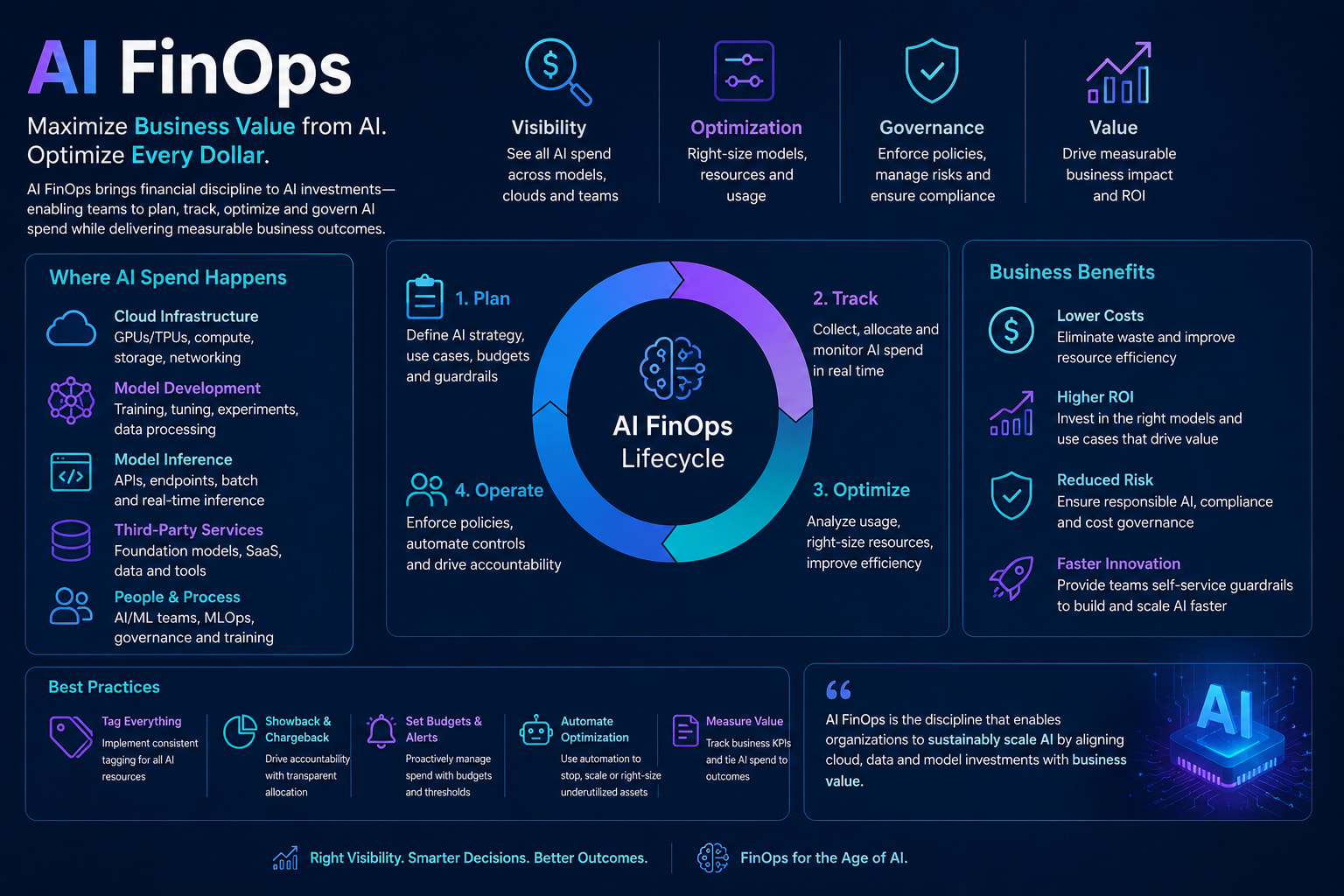
The Unseen Crisis: Why AI is Bankrupting Startups and Enterprises Alike
We are in the golden age of generative AI, but a silent killer is tearing through corporate balance sheets: Token API Overspending. While developers and product teams are busy stringing together agentic workflows, long-context prompts, and RAG pipelines, finance departments are waking up to heart-stopping invoices.
Companies are burning cash like paper simply because they are treating AI infrastructure the way they treat standard cloud computing. But LLMs don't scale like traditional microservices—every recursive tool call and unnecessary context token acts as a tax on your gross margins.
If you think this is just a problem for scrappy startups, think again. Just recently, in May 2026, Axios reported that an unnamed US enterprise received a staggering $500 million Claude API bill in a single month. The cause? Uncapped employee access, long-context payloads, and unmonitored agentic coding loops. In the same week, developer Peter Steinberger accidentally triggered a $1.3 million OpenAI bill during an unmonitored API experiment using OpenClaw.
The industry is suffering from "tokenmaxxing"—the habit of throwing the most expensive, heaviest frontier models (like GPT-4o or Claude 3.5 Sonnet) at every trivial task. Fortunately, cutting edge research and open-source tooling have given us a clear roadmap to fight back.
The Solutions: Research-Backed Optimization Techniques
You don't need to sacrifice reasoning capability to save money. Recent academic research points to highly effective strategies that can slash your API overhead by up to 90%.
1. Advanced Prompt Compression
Why pay to process redundant words? Prompt compression removes unnecessary tokens from the original prompt while preserving semantic meaning.
Generative Summarization: A brand-new 2026 framework called SCOPE (arXiv:2508.15813) uses small, fast summarization models (like BART) to dynamically compress input chunks based on relevance. It dramatically shortens prompts before they hit expensive APIs without needing to fine-tune the target LLM.
Recency-Weighted Compression: A March 2026 randomized control trial in production task orchestration proved that a "recency-weighted" compression algorithm—which drops earlier, lower-entropy tokens and preserves the most recent instructions—achieved a 23.5% immediate cost saving while sitting perfectly on the cost-similarity Pareto frontier (meaning zero measurable loss in output quality).
2. Dynamic Model Routing
Not every query requires the intellectual horsepower of GPT-4o. A massive portion of tasks (summarization, basic entity extraction, text classification) can be handled by incredibly cheap models like DeepSeek V4 Flash or Qwen3-32B, which cost up to 40x less. Dynamic routing analyzes incoming prompts and directs them to the cheapest model capable of completing the task at a high quality. Freelancers and indie hackers have reported slashing their API bills by 95% just by routing simple calls away from legacy walled gardens.
3. Semantic Caching
If two users ask the same underlying question but phrase it differently, you shouldn't be paying to compute the answer twice. Semantic caching sits between your user and the LLM, vectorizing the prompt and serving a cached response if the semantic similarity is high.
The Tech Stack: Open-Source Tools to Take Back Control
You don't have to build these optimization pipelines from scratch. The open-source community has stepped up with powerful toolkits designed strictly for LLM cost management:
LLMRouter (by ulab-uiuc): A brilliant open-source library that intelligently routes LLM inference by dynamically selecting the most suitable model for each query. It comes with custom fallback strategies and even a visual node-based workflow interface to easily build your routing pipeline.
AI Gateways & Observability: Tools like the TrueFoundry AI Gateway and Braintrust have become essential. They allow teams to set hard rate limits and budget caps per feature or employee, ensuring that an errant infinite loop doesn't result in a $500M invoice. They provide per-tool-call cost attribution, tracking every cent from retrieval steps to final token generation.
Stop Guessing. Let Zync Technologies Fix Your AI Economics
Cost optimization isn't just a technical challenge; it's a fundamental business survival skill in the AI era. But implementing custom compression layers, semantic caching, and dynamic routing takes engineering resources away from your core product.
That's where we come in. At Zync Technologies (zynctech.in), we provide full, end-to-end AI Cost Optimization Services.
We don't just audit your bills; we re-architect your inference layer. Our team will seamlessly integrate custom gateways, deploy state-of-the-art prompt compression, and implement intelligent, multi-model routing tailored to your specific application's latency and quality needs.
You built a great AI product. Now, let us make it profitable.
Visit zynctech.in today, and let’s turn your AI infrastructure from a cash bonfire into a hyper-efficient machine.