
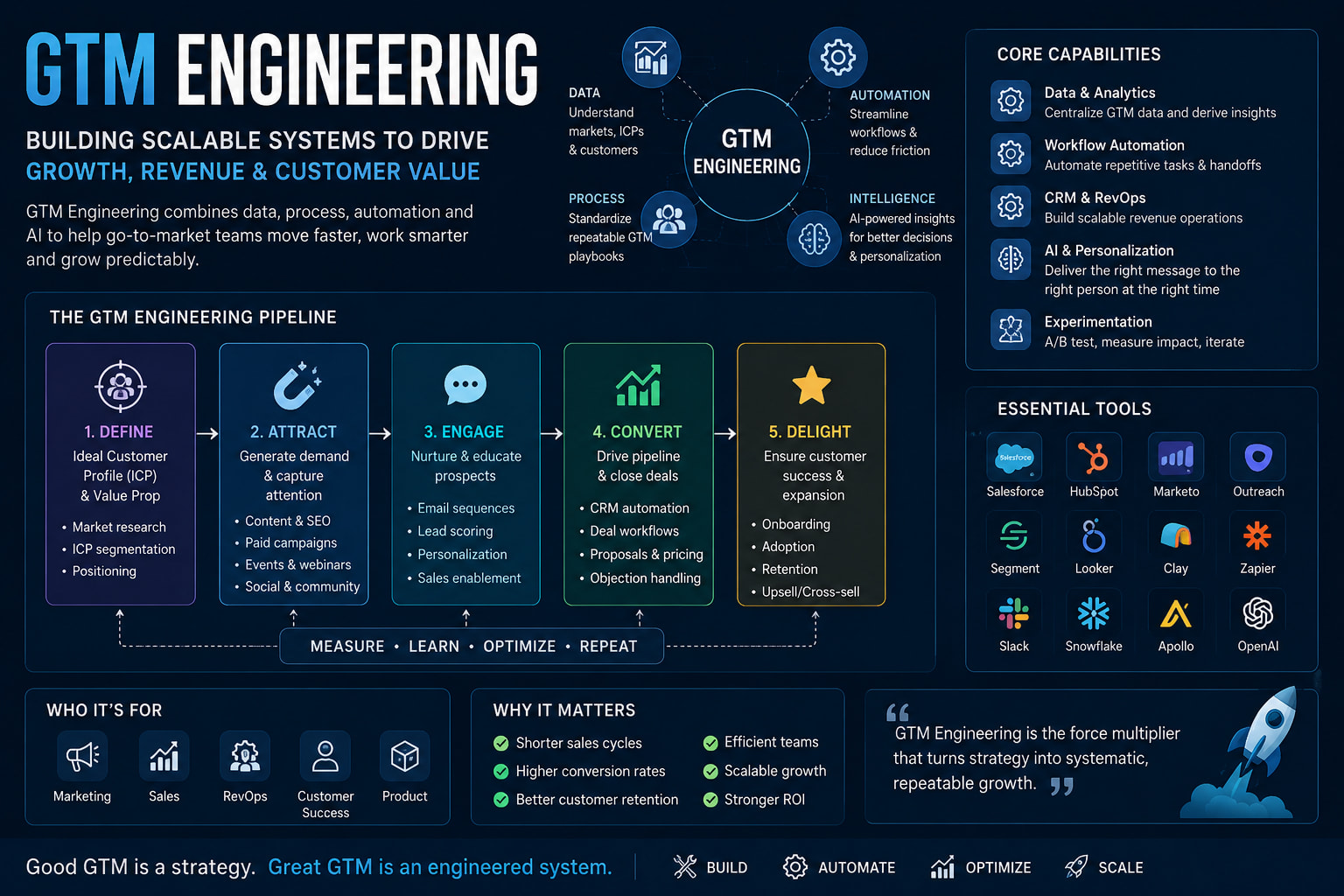
The days of relying purely on charisma and aggressive sales hiring to scale a startup are over. The modern Go-To-Market (GTM) strategy has evolved into a hardcore data and systems engineering problem. The buying cycle has become non-linear, and customer acquisition costs are skyrocketing—in fact, recent benchmarks indicate that B2B companies are now spending roughly $2 in sales and marketing just to earn $1 of new ARR. Adding more SDR headcount won't fix bad math.
To win, founders need to weaponize their system architecture. Startups with dedicated GTM engineering functions report 2.4x faster pipeline velocity and can run over 3x more outbound experiments per quarter.
Whether you are launching your MVP or scaling past $5M ARR, here is the ultimate technical GTM checklist to ensure your product launch is backed by a production-ready revenue engine.
1. Consolidate Your Signal Layer
The Beginner Mistake: Tracking website visits, ad clicks, and product usage in completely isolated silos.
The Fix: Build a unified signal pipeline. Modern buyer journeys are multi-threaded. You need an event-driven architecture that aggregates signals (e.g., job changes, funding rounds, product telemetry) and routes them into your CRM in real-time. If your sales team has to ask where a demo request came from, your data architecture is broken.
2. Implement Waterfall Enrichment
The Hack: Never rely on a single data provider.
The Fix: Relying on one vendor leads to massive data decay and domain-ruining bounce rates. By building an API waterfall—sequencing multiple enrichment providers (like ZoomInfo, Apollo, and Clearbit) based on match rates—GTM engineers can increase valid email rates from a baseline of 55-60% up to 90%+.
3. Deploy Autonomous RevOps Pipelines
The Beginner Mistake: Manually downloading and uploading CSVs between marketing and sales tools.
The Fix: The average B2B revenue stack now runs on 14 to 17 different tools. Connecting them requires robust webhook orchestration. Leverage open-source workflow automation tools like n8n to build self-healing pipelines that route leads, update CRM records, and trigger slack alerts without human intervention.
4. Build a Zero-Latency Executive Telemetry Dashboard
The Hack: Stop flying blind or waiting for weekly reports.
The Fix: Founders need a centralized command center. Instead of paying exorbitant enterprise fees, use open-source visualization platforms like Grafana or Metabase connected directly to your data warehouse. Track real-time server health, burn rate, and CAC all in one multi-tenant dashboard.
5. Enforce Sub-5-Minute "Time-to-First-Touch"
The Metric: Speed to lead is the ultimate conversion multiplier.
The Fix: Your GTM architecture should be optimized for latency. Set up automated triggers that enroll high-intent inbound leads into personalized multi-channel sequences within 5 minutes of a detected signal.
6. Standardize on Open-Source Analytics
The Beginner Mistake: Paying thousands of dollars for proprietary product analytics when you're still early-stage.
The Fix: Embed analytics directly into your product to track user friction during onboarding. Open-source platforms like PostHog (for comprehensive product analytics and session replays) and Plausible (for lightweight, privacy-friendly web analytics) are highly scalable and cost-effective.
7. Optimize Edge-Rendering & Core Web Vitals
The Hack: Treat your landing pages like production applications.
The Fix: A slow-loading frontend will obliterate your ad spend ROI. Ensure your GTM assets utilize Server-Side Rendering (SSR) and edge-computing. Passing Google’s Core Web Vitals isn't just about SEO; it’s about reducing bounce rates when you finally drive intent-driven traffic to your site.
8. Automate Intent Scoring with LLM Pipelines
The Beginner Mistake: Blasting identical generic emails to every lead in your database.
The Fix: Move past basic API wrappers. Deploy advanced agentic frameworks and Vector DBs to read prospect data, categorize their pain points, and draft highly personalized messaging. AI-native GTM teams ship significantly more output than teams relying on manual personalization.
9. Implement Production-Ready Observability
The Hack: Know when your revenue engine breaks before your customers do.
The Fix: When webhooks fail or data integrations break, leads vanish into thin air. You need observability for your RevOps. Open-source tools like SigNoz (a full-stack Datadog alternative) or OneUptime allow you to trace API bottlenecks and log errors across your entire microservices architecture.
10. Design "Human-in-the-Loop" Architectures
The Beginner Mistake: Fully handing customer outreach to an autonomous AI SDR. It rarely works in today's noisy landscape.
The Fix: The best GTM engineering creates leverage, not a complete replacement of the human element. Automate the enrichment, the routing, the signals, and the draft generation—but mandate a human-in-the-loop for final approval on high-value enterprise accounts. AI handles the scale; humans handle the nuance.
Stop Patching Systems. Start Engineering Revenue.
Setting up a production-ready GTM infrastructure requires serious technical heavy lifting. You can spend weeks trying to connect the APIs, configure the webhooks, and debug your cloud bill—or you can let the experts handle the system architecture while you focus on closing deals.
Zync Technologies specializes in Optimization, GTM Engineering, and RevOps for both tech and non-tech founders. We build the agentic workflows, executive dashboards, and robust architectures that scale natively.
Don't let a fragile backend ruin your launch. Book a free discovery call right now at zynctech.in and let's map out your high-octane revenue architecture today.